BMX Space
- 4.6
- Rating
- 10.00M
- Installs
- Free
- Price

 Analysis by App-foxy
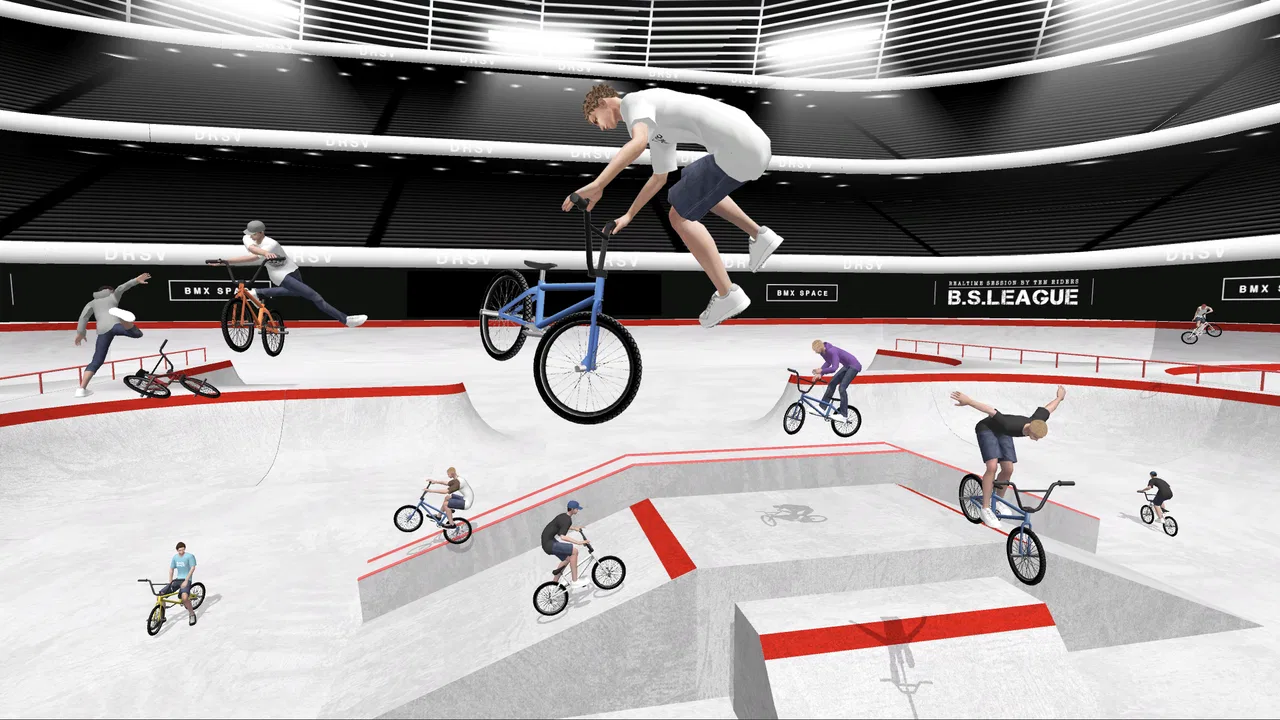
I picked up BMX Space expecting a quick BMX game and found something closer to a shared playground than a traditional sports campaign. The main appeal is riding through custom parks, practicing lines, and joining multiplayer online sessions where the fun comes from what you choose to do with the space. It is free to play, rated for Everyone, and developed by DRSV, LLC., so it is easy to try without treating the first session like a major commitment.
That description also explains the game’s biggest strength and its main limitation. This is not the kind of BMX title that constantly pushes a player through a tightly scripted sequence of races. Its goals are more personal: learn the controls, find a park that suits your style, build confidence on ramps and obstacles, and spend time riding with other people. If you enjoy making your own objectives, it can feel surprisingly welcoming. If you need a clear checklist, frequent rewards, and a strong story of progression, the open-ended design may feel light.
How the first sessions establish a reason to keep riding
The early experience works best when I approach it as a practice session rather than a competition. I first want to understand how the bike responds, how much space a trick needs, and which parts of a park are comfortable for repeating a move. That sounds simple, but it gives the opening minutes a useful purpose: every failed landing teaches me something about timing, positioning, or the shape of the obstacle.
You May Also Like

 Google Keep - Notes and lists
Google Keep’s Quiet Growth Shows the Appeal of Simpler Notes
As mobile work gets busier, Google Keep keeps winning a simple contest: capture a thought quickly, find it later, and get on with the day.

 Blood Strike: 2.5 Anniversary
Blood Strike’s Loadouts Turn Every Drop Into a Tactical Gamble
A close look at Blood Strike’s custom loadouts: how fast access to signature weapons reshapes its battle royale rhythm, rewards preparation, and narrows the gap between fights.

 Pandora - Music & Podcasts
Pandora’s Music Is Easy to Start, but Harder to Recover
Pandora’s strength is its low-effort path from a seed to a station. Its weak spot is how much confidence it asks you to place in connection, setup, and quiet recovery.

 8 Ball Pool
 Is Built on Rivalries, Rematches, and Routine
A close look at the rivalries, rematches, shared routines, and unanswered safety questions that turn a quick pool match into a persistent mobile community.

 Samsung Music
’s Quiet Strength Is Playing What You Already Own
Its reach comes less from spectacle than from dependable access to a personal library. That simplicity is both the app’s strongest retention engine and its ceiling.

 AccuWeather: Weather Radar
AccuWeather Review: A Quick, Clear Forecast for Everyday Decisions
For everyday plans, the best forecast is the one you can understand quickly. AccuWeather makes rain timing, radar, and local conditions easy to act on, with a few trade-offs.
More From Our News Desk



The custom-park focus is important here. Instead of learning one fixed course and moving on, I can look for environments that change the kind of riding I want to attempt. A compact park is better for repeating a short sequence, while a more open layout gives me room to connect ramps and experiment with a longer line. This variety makes the first goals feel self-directed rather than imposed.
For a new player, I recommend setting a small target before worrying about impressive riding. Try to complete one clean run through a familiar section, then repeat it without rushing. That approach makes the controls easier to read and prevents the usual mistake of attempting the most complicated move before understanding the landing. The best early goal is consistency, not spectacle.
The online element can change that rhythm. Seeing other riders in the same general space gives the game a social presence that a solo BMX practice title cannot provide. I find it more enjoyable when I treat multiplayer as a place to observe routes and discover ideas, not as a demand to prove that I am the best rider there. A player who is comfortable learning by watching others will get more from the shared-session format.
At the same time, the game does not seem designed around making every newcomer feel guided through a formal lesson plan. That can be liberating, but it also means I have to create my own structure. I would not recommend it to someone looking for a heavily narrated sports game with a clear career ladder from beginner to champion. BMX Space is more satisfying when the player accepts that exploration itself is part of the objective.
What counts as progress when the game is built around parks?
Progress here is easier to notice through improved control than through a conventional sports-game scoreboard. I can return to a section that felt awkward and find that the same obstacle now looks manageable. I can also begin choosing a line for a reason, rather than simply reacting to whatever ramp appears next. Those are quiet improvements, but they are meaningful in a game centered on riding technique and personal style.
The parks act as progress signals because each layout asks different questions. One may reward careful setup, while another encourages a faster sequence of transitions. Moving between them helps reveal whether I truly understand the bike or have only memorized one comfortable route. This is one of the more interesting trade-offs in the design: variety keeps practice fresh, but it can also make improvement feel less measurable than in a game with explicit event results.
Players who enjoy unlocks should set expectations carefully. The satisfying form of advancement is discovering more of what the park selection and multiplayer space can offer, then using that knowledge to ride with greater control. I would not install this expecting a constant stream of dramatic unlock moments. Its motivation comes from mastery, experimentation, and the desire to make a run look or feel better than the last one.
A useful routine is to divide a session into three parts. I spend the first few minutes warming up on a familiar obstacle, use the middle of the session to explore a different park, and finish by returning to the original section to see whether the new practice helped. This gives the game a beginning, middle, and end even when it does not impose one. It also stops exploration from becoming aimless wandering.
The multiplayer setting creates another kind of progress signal: confidence around other riders. At first, I may focus only on surviving a line without falling out of rhythm. Later, I can attempt a route while other players are nearby, or use their movement to understand how a section flows. That social learning is easy to overlook, but it is one of the reasons the game feels different from a purely offline BMX sandbox.
Difficulty, pacing, and the cost of learning by repetition
The difficulty curve is less about enemies becoming stronger and more about the player demanding more from the same controls. A basic route can feel approachable, while a longer sequence becomes difficult because every small error carries forward. This is a fair kind of challenge for players who like repetition, since improvement usually comes from making one part of the run more reliable at a time.
Still, the pacing can feel uneven if I arrive expecting constant action. A session may alternate between exciting movement, careful positioning, and repeated attempts that look almost identical. That slower rhythm suits practice-minded players, but it can test the patience of someone who wants immediate variety. The custom parks help prevent the game from becoming completely static, yet they do not remove the need to spend time learning.
My most practical tip is to stop changing variables too quickly. If I switch parks, attempt a new trick, and alter my route after every failure, I cannot tell what caused the mistake. Repeating one section several times makes the feedback clearer. Once the movement feels dependable, changing the environment becomes useful again because I can focus on adapting rather than relearning everything at once.
This is also where the game compares favorably with many quick-match sports alternatives. A conventional arcade sports game often gives me an obvious win-or-lose result, which is satisfying in short bursts. BMX Space offers a more personal form of challenge, but it asks me to judge whether a run was successful. I prefer that when I want to practice and experiment; I prefer a structured match when I only have a few minutes and need an immediate objective.
The game is not automatically easy simply because it is suitable for Everyone. That age rating makes it broadly accessible, but the physical timing of BMX riding can still frustrate younger or less experienced players. I would introduce it gradually: learn the basic movement in a quiet area, then move toward busier sessions once the player is comfortable. The absence of a harsh competitive requirement makes that learning process less intimidating.
Does the online format sustain interest?
The multiplayer sessions are the clearest source of long-term variety. A shared park changes the feeling of a ride because I am no longer only testing myself against the layout. I can watch how other players use the same space, borrow ideas for routes, or simply enjoy the atmosphere of several riders practicing in parallel. That makes the game feel more alive than a solitary stunt playground.
However, online presence is not the same as deep competitive structure. If I need ranked seasons, formal tournaments, or a carefully balanced progression track, this is probably not the right choice. The appeal is closer to meeting in a digital skatepark and finding something interesting to do. That can produce memorable sessions, but it also depends heavily on whether I am in the mood to create my own entertainment.
One effective way to keep the multiplayer experience fresh is to give each session a theme. I might spend one visit looking for the cleanest line through a park, another trying to follow a route suggested by a rider I noticed, and another focusing only on smooth landings. These self-imposed challenges are more rewarding than mindlessly repeating the same stunt because they turn the open format into a series of small experiments.
There is a retention pressure here, but it is subtle. The game does not need to force me forward with a dramatic cliffhanger; it relies on the thought that I can improve a run, find a better park, or have a more enjoyable session next time. That is a healthy loop for players who like gradual mastery. It is weaker for anyone who loses interest when there is no clearly announced next milestone.
The free entry helps lower the barrier to trying that loop. The game costs nothing to start, while optional in-app purchases range from $0.99 to $19.99 per item. I would treat those purchases as a separate decision rather than part of the reason to install. The core question is whether the riding and park exploration are enjoyable before spending anything. For me, that is the sensible order: play first, decide later.
Because the game has reached over ten million installs, it is not an obscure experiment with no established audience. Its average rating is 4.5 from roughly forty-two thousand ratings, with about 1.8 thousand written reviews. Those figures suggest that the central idea connects with many players, although they should not replace a personal test of the controls. BMX games are especially dependent on whether the movement feels natural to the individual player.
Who will enjoy it, and who should choose something else?
I would recommend this game to someone who likes BMX riding as a creative activity rather than only as a race. It suits players who enjoy trying the same line until it feels smooth, exploring different custom parks, and sharing space with other riders. It is also a good fit for casual sessions where I want something active but do not want to follow a long campaign or manage a detailed team.
It works particularly well in an everyday situation such as a short break after work or school. I can open it with a simple plan—practice one transition, explore one unfamiliar park, and spend a few minutes in an online session—then stop without feeling that I abandoned a complicated campaign. That flexibility is valuable on mobile, where playtime is often interrupted.
I would skip it if my priority is a realistic BMX simulation with extensive equipment tuning, or a traditional sports career with clearly presented seasons and trophies. I would also look elsewhere if I need every session to deliver a visible reward. The open-ended format can feel empty when I am tired and want the game to tell me exactly what to do next.
Compared with a standard arcade sports game, BMX Space gives up some immediate structure in exchange for freer movement and park-based experimentation. Compared with a pure solo stunt game, its online sessions add a social dimension that can make familiar spaces feel less predictable. Neither comparison makes it universally better. The right choice depends on whether I value self-directed riding more than a formal sequence of events.
Device compatibility is reasonably broad: the current version is 1.036 and it runs on Android 7.0 or later. That makes it approachable for people who are not using a recent phone, although the practical feel of any 3D riding game can still vary with the device and connection. I would make sure the game feels responsive before committing to demanding multiplayer practice, since timing matters more than visual detail when landing a difficult line.
My verdict on the progression and staying power
BMX Space sustains play through a combination of custom-park discovery, increasingly confident riding, and the unpredictable energy of multiplayer sessions. Its early goals are easy to invent, its progress signals are mostly skill-based, and its difficulty grows when I attempt longer or cleaner lines. That design is coherent, but it is not designed to satisfy every kind of sports-game player.
What I appreciate most is that the game gives me room to decide what a successful session means. A clean run, a newly understood obstacle, or an enjoyable shared ride can all count. The trade-off is that the game rarely supplies the same strong external pressure as a campaign or competitive ladder. If I need explicit unlocks and constant challenge prompts, the pacing may lose me.
For my own use, I would keep it installed as a relaxed BMX playground rather than treat it as my only sports game. The free price makes that recommendation easy, and the Everyone rating makes it suitable for a broad audience, while the optional purchases are worth considering only after the basic experience has earned your interest. My progression verdict is positive for self-motivated riders: the game rewards patience and experimentation more than checklist completion.
In short, this is a good choice when you want to ride, explore, and share a park without being pushed through a rigid career. It is less convincing when you want a complete competitive framework or a constant stream of formal rewards. If that distinction matches what you are looking for, BMX Space offers a surprisingly flexible way to spend a few minutes—or a much longer session—on two wheels.
FAQs for BMX Space
01What is BMX Space and what can users expect from it?
BMX Space is a virtual BMX biking simulation game available on Android and iOS. Users can expect an immersive experience with realistic 3D graphics and physics. The game offers various tracks and customization options for bikes and characters, allowing players to explore and perform tricks in a virtual BMX park.
02Is BMX Space free to play, and are there in-app purchases?
BMX Space is free to download and play on both Android and iOS platforms. However, it does offer in-app purchases that allow users to buy customization items, unlock additional tracks, or remove ads. While the game is accessible without spending money, these purchases can enhance the gaming experience.
03What are the device requirements for BMX Space?
BMX Space requires a device running at least Android 5.0 or iOS 10.0. It's important to have a stable internet connection for downloading and accessing certain features. The game is optimized for both smartphones and tablets, but performance may vary based on the device's specifications.
04Can players customize their BMX bikes and characters?
Yes, BMX Space offers extensive customization options. Players can personalize their BMX bikes with different colors, parts, and decals. Additionally, characters can be customized with various outfits and accessories, allowing for a unique experience tailored to each player's style.
05Is there a multiplayer mode in BMX Space?
BMX Space includes a multiplayer mode, allowing players to compete against others online. Users can join multiplayer sessions to show off their skills, compete in trick challenges, or simply enjoy a casual ride with friends. This feature adds a social element, enhancing replayability and engagement.
Pros
- Smooth graphics enhance gameplay.
- Customizable BMX bikes and avatars.
- Engaging multiplayer mode available.
- Frequent updates with new content.
- User-friendly controls for easy play.
Cons
- Occasional in-app ads can disrupt.
- Requires internet for full features.
- Limited offline gameplay options.
- Some features locked behind paywall.
- Initial load times can be lengthy.

BMX Space
Gallery